Poppy AI Alternatives in 2026: 5 Tools Compared

Updated October 2026 · prices checked Oct 8

Every alternative has a board now. Compare what the AI does on it.

Poppy made the AI canvas popular, and now almost every alternative has a board. The real differences are what the AI does on that board, what it remembers, and what a year costs.

Poppy AI built this category. It showed creators that sources, research and scripts belong together on one board instead of scattered across chat threads, and it grew fast. That success brought a wave of lookalikes: tools that copy Poppy's layout, its pricing and its pitch, often feature for feature.

We left the lookalikes out. If Poppy's approach is what you want, Poppy does it best. Each of the five tools below does something Poppy doesn't, which is the only good reason to switch.

Written by the Nodeflow team. Nodeflow is on this list, and each section says who the tool suits best, including when that's another tool.

Why people look for a Poppy AI alternative

Annual billing only

The Base plan is $399 a year. A $1 trial gives you seven days, then the annual plan starts unless you cancel.

Monthly credit caps

Base includes 2,000 credits a month. Busy research months can run past that.

Workflow fit

Poppy is built around studying content that already won and recreating its pattern. If your work starts from your own goal and knowledge, or you want video generation, it's a weaker fit.

Feature comparison

FeatureNodeflowPoppy AIBlortAI Flow ChatNotebooks.appGemini Notebook
AI agent builds and edits the board✓–––––
AI chat grounded in your sources✓✓✓✓✓✓
AI draws on your saved brand, research and past work✓✓––––
AI learns from your past conversations✓–––––
Visual canvas or whiteboard✓✓✓✓✓–
Team collaboration✓✓–––✓
Scheduled AI routines or workflows–––✓––
YouTube sources✓✓✓✓✓✓
TikTok and Instagram sources✓✓✓✓✓–
PDFs and web pages✓✓✓✓✓✓
Built-in viral content library––✓–––
Meta ads research–✓–✓––
Choice of AI models✓✓✓✓✓–
Writes in your brand voice✓✓✓–✓–
Image generation✓✓✓✓–✓
Video generation from prompts✓–––––
Monthly billing✓–?✓✓Free
Free plan–––––✓
Trial✓$1✓✓✓Free
Money-back guarantee14 days30 days–––Free

What a year costs

ToolEntry plan with AI, per yearTrial or free useRefunds
Nodeflow$200Free trial14-day money-back
Poppy AI$399 (Base)$1 for 7 days30-day money-back
Blort$300 (Basic) to $396 (Pro)7-day trialNo refunds
AI Flow Chat$348 billed monthly; about $278 billed annually7-day free trialNot stated
Notebooks.app$348 ($29 a month, no annual plan)Free start, no cardNot stated
Gemini NotebookFreeFreen/a

Pricing sources, checked October 8, 2026: Nodeflow · Poppy AI · Blort · AI Flow Chat · Notebooks.app · Gemini Notebook

1. Nodeflow: an AI agent that works on your board and learns your business

Nodeflow started where many Poppy alternatives start: a canvas with AI chat attached. Nebulae acquired Nodeflow in 2025 and in 2026 rebuilt it on Parmind, a knowledge management platform (release notes). That changed what it is. Three things set it apart.

The agent works on the board, not beside it

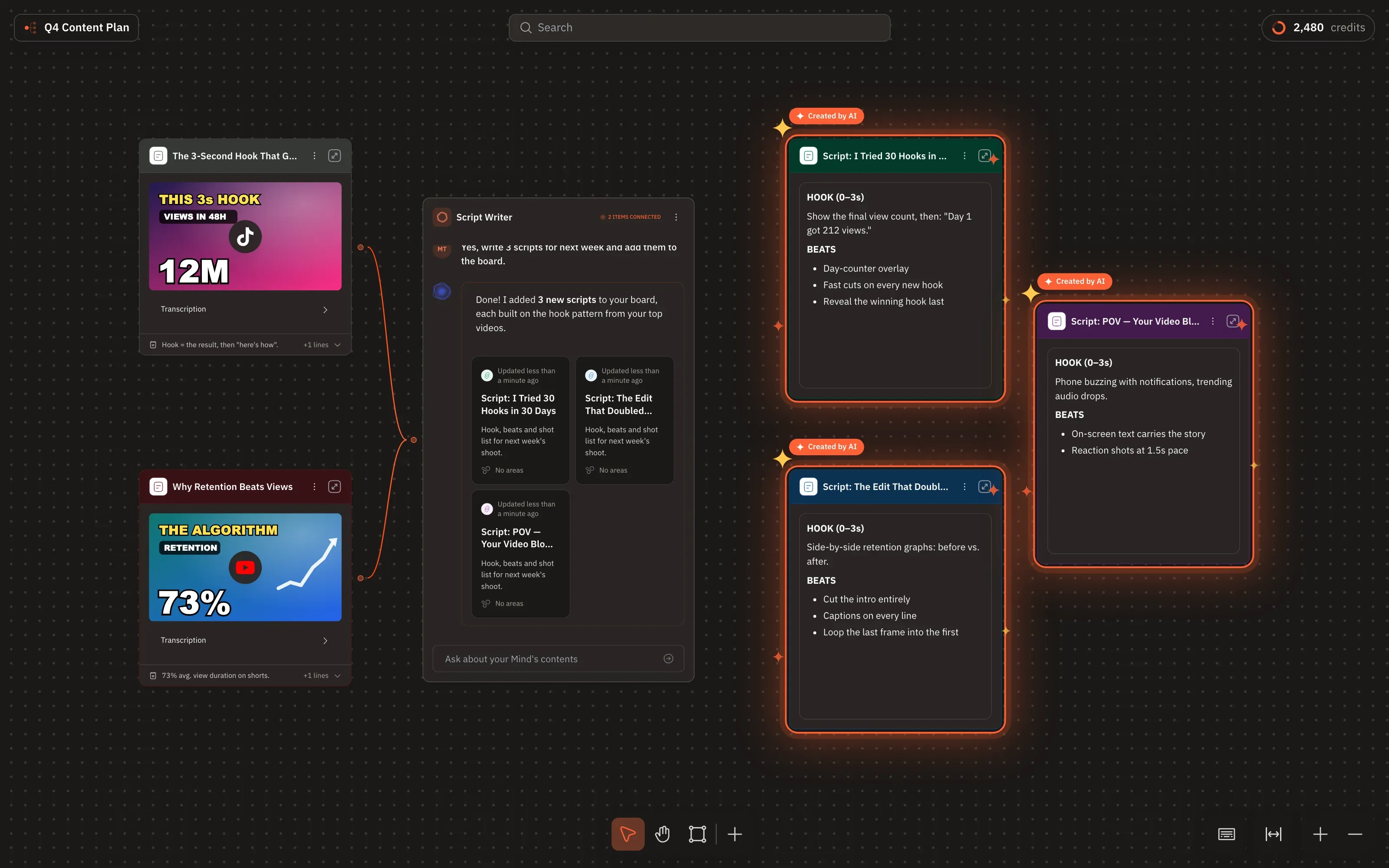
Nodeflow Script Writer agent creating three new script nodes directly on the board

In most canvas tools you connect sources to a chat node, type a prompt and get text back. In Nodeflow you describe a goal, such as "research these two videos, find the strongest angles and outline a script", and the agent sets up the board for it.

It reads every node on the board, creates research and outline nodes, connects them and drafts. Each step lands on the canvas, so you can check it, edit it or point it somewhere else.

It knows your business, and keeps learning

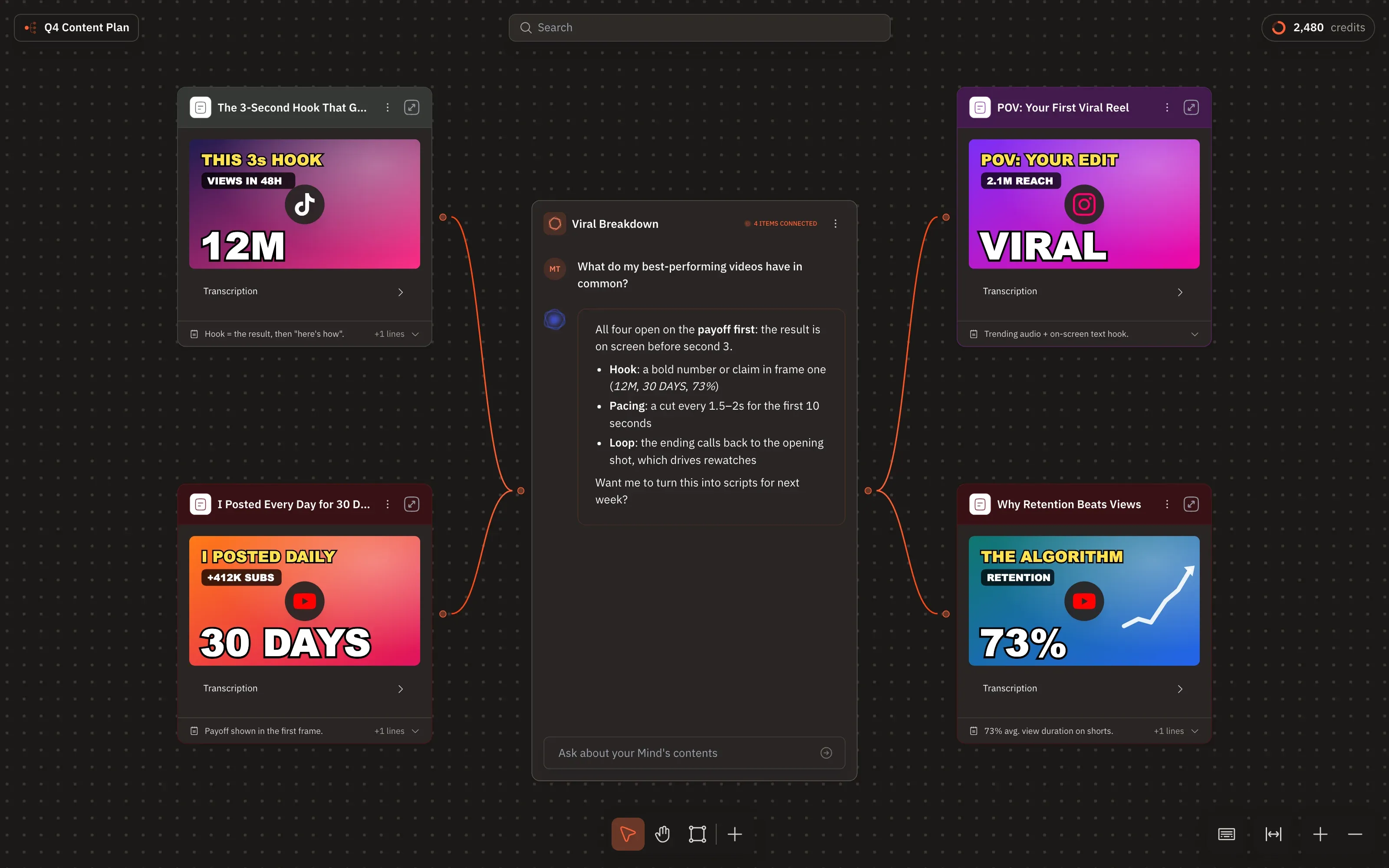
Nodeflow agent answering what four top-performing videos have in common, drawing on the Mind knowledge base

The agent has access to your whole workspace: every node you've added and every past conversation, across all your boards. It processes that material as you work, so it builds an understanding of your business, your audience and what you've made before. That's also how it writes in your voice: from your own work, not a profile you fill in.

A new project starts with that context instead of from zero.

Video generation on the same canvas

Generate video with Seedance, Hailuo or Kling without leaving the board, next to the research and script it came from. Image generation and chat with ChatGPT, Claude and Gemini work on the same canvas.

Nodeflow at a glance

Price

$200 a year, or a monthly plan. Free trial and a 14-day money-back guarantee.

Sources

YouTube, TikTok, Instagram, X, web pages and PDFs. YouTube transcription doesn't use credits.

Teams

Real-time collaboration on the same board.

Limits

Newer than Poppy, with fewer templates and a smaller community. No Meta ad research.

Best for

Creators, writers and small teams whose research should carry from one project to the next, and who want video on the same canvas.

For pricing, credits and refund terms side by side, see Nodeflow vs Poppy AI.

2. Blort: a viral video library next to your whiteboard

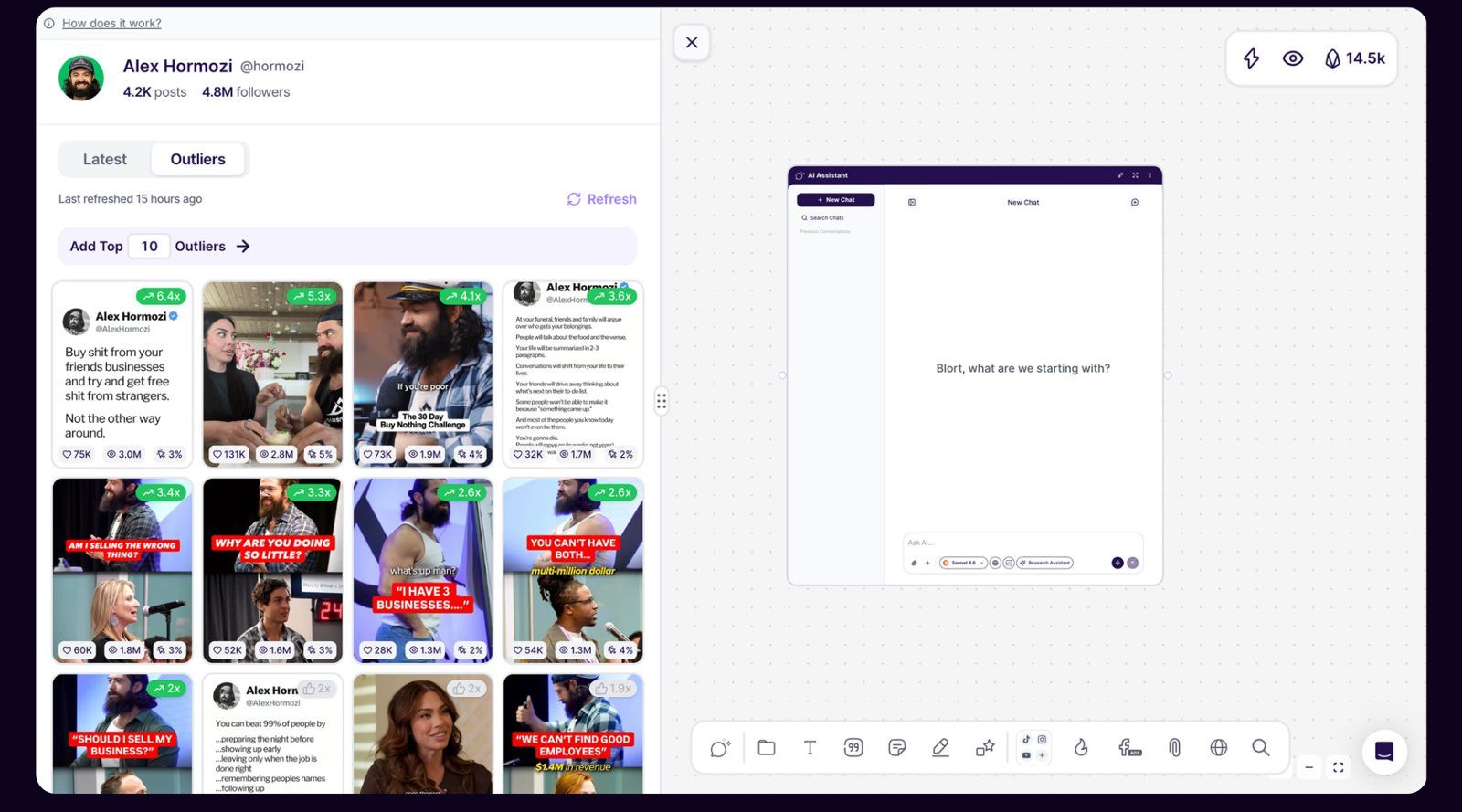
Blort outlier video library next to an AI chat

Blort describes itself as your own creative strategist: it finds a competitor's best content, breaks it down frame by frame and helps you adapt it for your product.

Standout feature: a library of over a million outlier videos from Instagram, TikTok and YouTube, sorted by how far each one beat its creator's average. Drop any of them into a chat and the AI breaks down the hook, format and pacing, or turns it into your own script. It can also audit any creator's top hooks, formats and posting cadence. Sources include TikTok, Instagram, Facebook, YouTube, X, Loom and Google Drive, plus PDFs, images, MP4s, CSVs and websites. An API connects boards to Zapier, Make and n8n.

Pricing: Basic is $25 a month billed yearly ($300 a year, 8,000 credits a month). Pro is $33 a month billed yearly ($396 a year, 16,000 credits and priority support). Both include GPT, Claude and Gemini, image generation with GPT Image and Nano Banana, 50 templates and a 7-day trial. Blort doesn't offer refunds.

Good fit: short-form and ad creators who start from proven formats.

Less of a fit: at $396 a year, Pro costs about the same as Poppy's Base plan, and the approach is close to Poppy's too.

Compared with Nodeflow: Blort starts from other people's viral videos. Nodeflow starts from your goal and your own knowledge base, and adds video generation, for $200 a year.

3. Notebooks.app: built around your YouTube channel

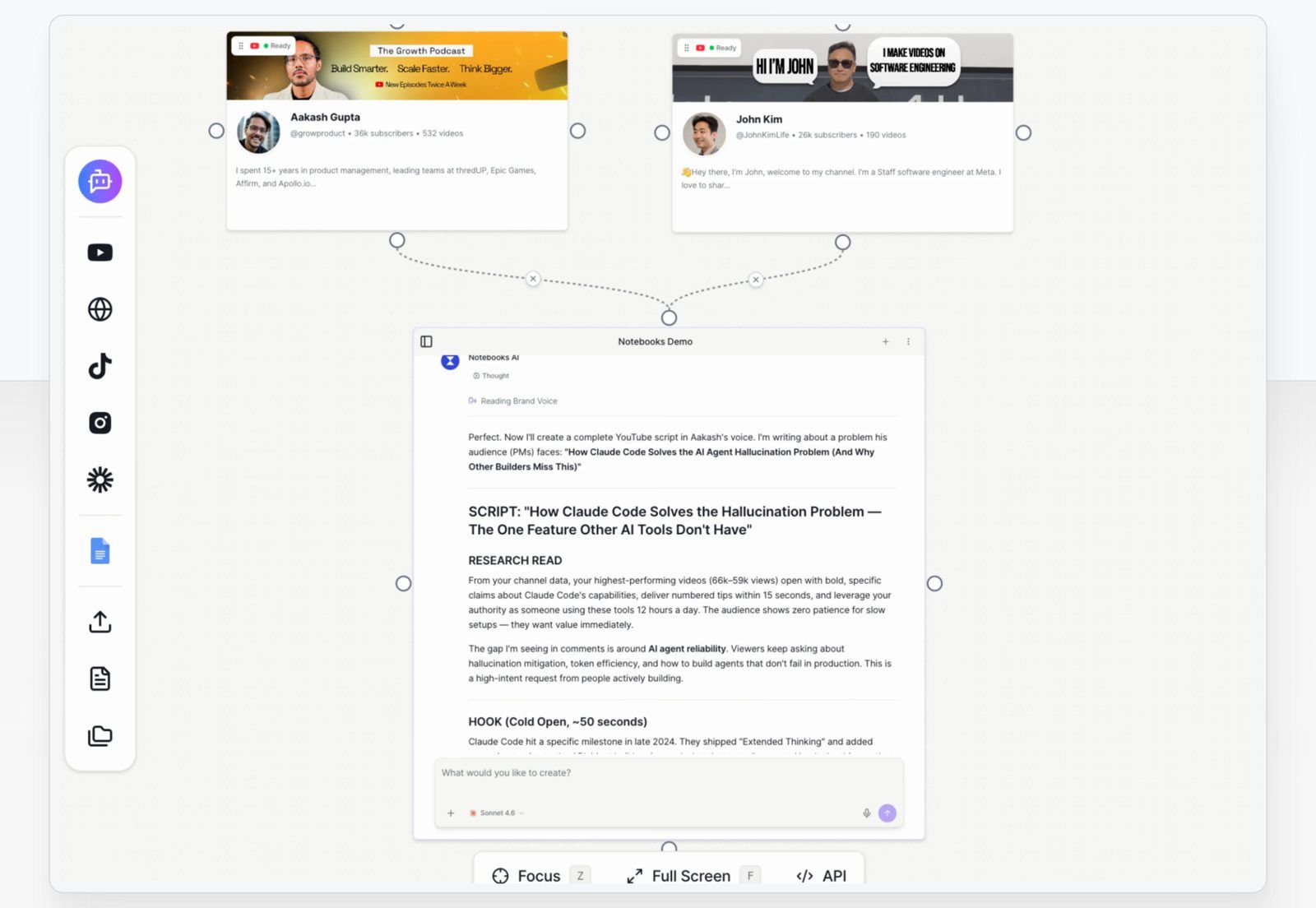
Notebooks.app whiteboard with YouTube sources connected to a script

Notebooks.app is an AI whiteboard for content creators. You drop in your YouTube channel, Instagram profile, competitor channels, PDFs, Reddit threads and articles, connect them to Claude, ChatGPT or Gemini, and generate scripts and posts.

Standout feature: it connects to your own YouTube channel and analyzes the videos themselves, not only transcripts, so scripts are modeled on what already works for your audience. Voice notes become written notes, and images work as sources too.

Pricing: monthly only. Starter is $29 a month ($348 a year) with 5 notebooks and 1,500 credits. Pro Creator is $49 a month ($588 a year) with unlimited notebooks and 2,500 credits. Credit use depends on the model and input size; Notebooks' own example is about 5 credits for a 1,200-word post built from three YouTube videos. You can start without a card.

Good fit: YouTube creators who want research and scripting in one place, month to month.

Less of a fit: no collaboration, image or video generation listed, and Starter's 5-notebook cap fills up quickly.

Compared with Nodeflow: both work well with YouTube. Nodeflow's YouTube transcription doesn't use credits, its agent builds the board instead of waiting for a prompt, and a year costs $200 instead of $348.

4. AI Flow Chat: turn a content process into an app

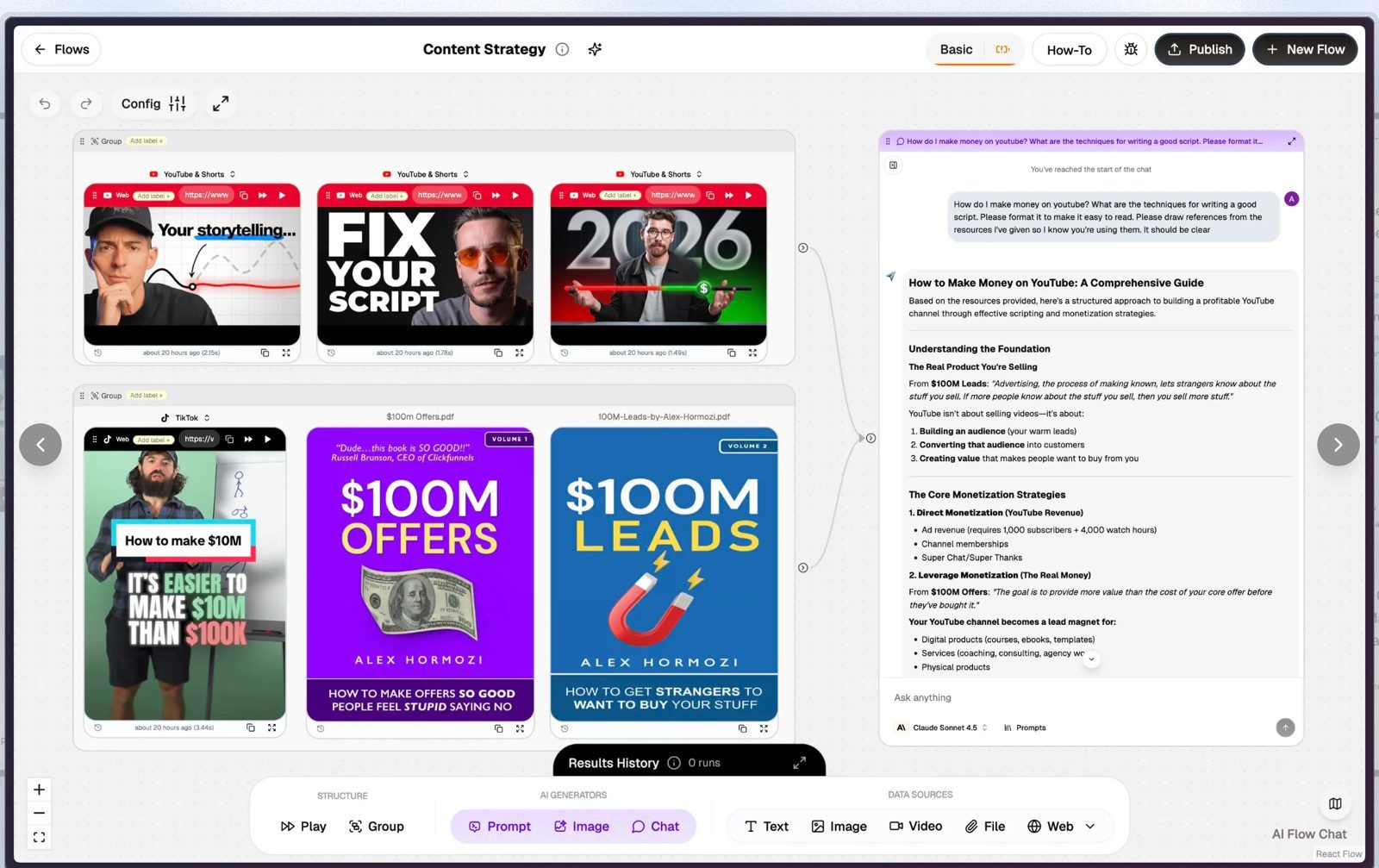
AI Flow Chat flow with YouTube sources feeding a chat

AI Flow Chat is an AI canvas for creators and marketers with a builder for repeatable workflows. The idea: build an AI system once instead of re-prompting yourself every week.

Standout feature: flowcharts that become apps. You chain sources, prompts and models into a flow, package it as an app with public or private sharing, and run it on a schedule. There's a reusable prompt library, community templates, image generation, and a Notion integration that pulls docs, wikis and SOPs into a workflow. Sources include YouTube, PDF, DOCX, Notion, TikTok, Reels, video files, X posts and videos, web pages and Meta ads, with audio files listed as coming soon.

Pricing: Basic is $29 a month (8,000 credits, 5 app schedules) with a 7-day free trial for new customers. Scale is $59 (18,000 credits, 50% rollover, 10 schedules) and Pro $119 (40,000 credits, full rollover, 15 schedules). Annual billing saves 20%, and extra credits cost $6 per 1,000.

Good fit: marketers with a process they repeat every week: SEO articles, ad variants, repurposing.

Less of a fit: it rewards a systems mindset and is closer to a workflow engine than a space to think. No video generation listed.

Compared with Nodeflow: in AI Flow Chat you design the workflow; in Nodeflow you describe the goal and the agent sets up the board. Nodeflow also keeps what it learns about your business from one project to the next.
5. Gemini Notebook (formerly NotebookLM): the free option for research

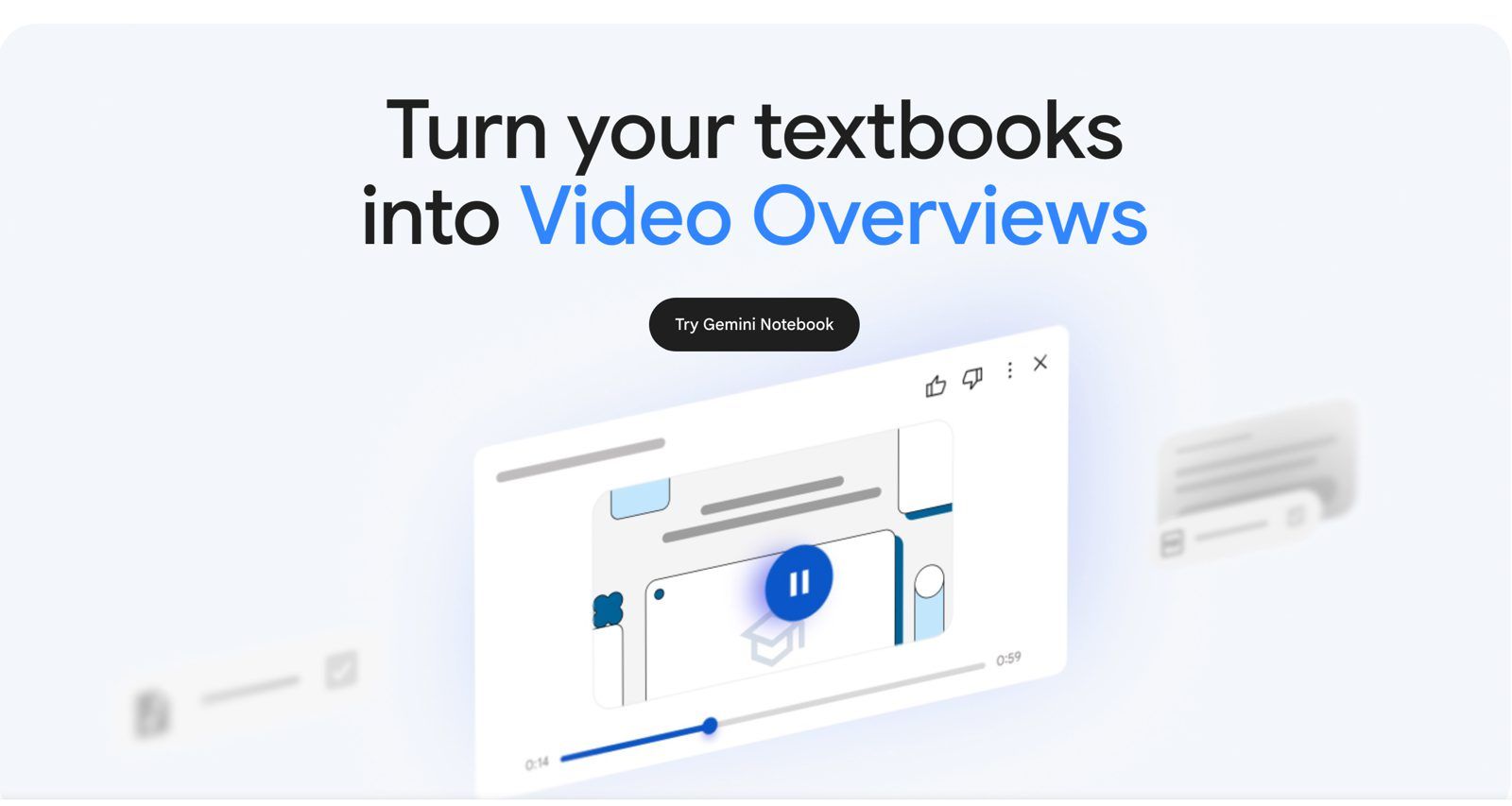
Gemini Notebook homepage showing Video Overviews

Gemini Notebook is Google's research notebook, renamed from NotebookLM. You add documents, links and YouTube videos, and every answer is grounded in those sources.

Standout feature: turning sources into other formats. Gemini Notebook generates Audio Overviews (podcast-style discussions), Video Overviews, slides, infographics, reports, flashcards and quizzes. Deep Research and source discovery find new material for you, and you can share notebooks publicly.

Pricing: free with a Google account, with up to 50 sources per notebook. Google AI Plus, Pro and Ultra subscriptions raise the usage limits and allow 100, 300 or 600 sources per notebook.

Good fit: testing whether you need a paid workspace at all, and working through long documents.

Less of a fit: no canvas, no TikTok or Instagram sources, and no workflow for producing social content.

Compared with Nodeflow: Gemini Notebook is a strong free way to study sources. Nodeflow puts those sources on a board where an agent turns them into scripts, images and video.

When staying with Poppy makes sense

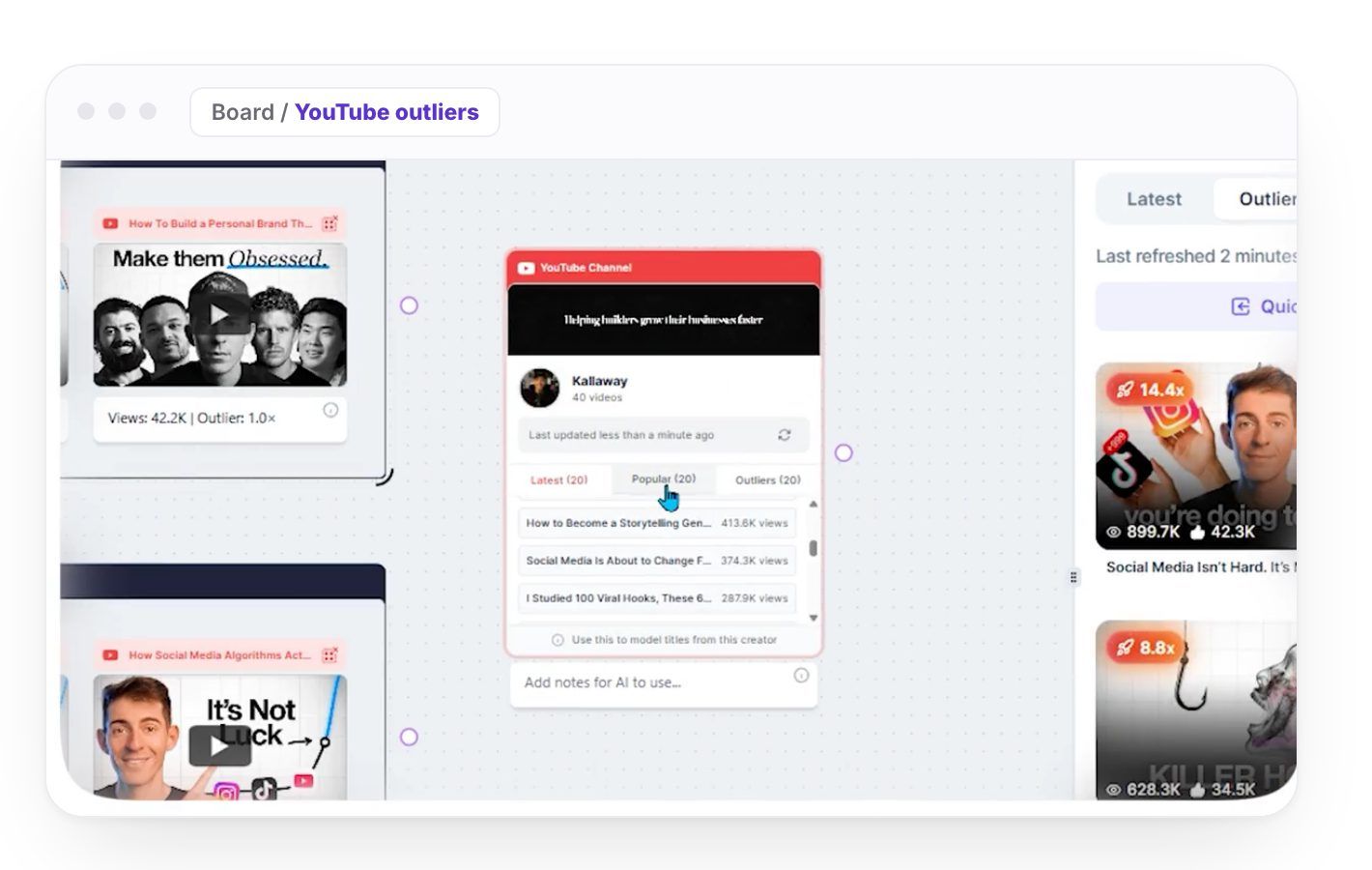
Poppy AI board with YouTube outlier research

Poppy AI is the most established tool here, used by 13,000+ creators, founders and marketers according to its site. It starts from proof: you drop in videos, ads and posts that already won, Poppy analyzes why they worked (hooks, angles, structure, offer), then builds new content on those patterns in your voice.

What it does well: one workspace per brand that keeps voice, offer, research, competitors and past winners together, which suits agencies. It writes YouTube and short-form scripts, ads, emails, VSLs, newsletters and landing pages, and researches live Meta ads. Higher plans add seats, chatbots, agents and an API.

Pricing: Base is $399 a year with 2,000 credits a month. Creator is $2,268 a year with 8,000 credits and 3 seats; Power User is custom. A $1 trial gives you seven days, and there's a 30-day money-back guarantee.

Stay if annual billing suits you, your usage fits the credit allowance, and your process starts from content that already won. Switch if you'd rather start from your own goal and knowledge, need video generation, or want to pay less per year. For a feature-by-feature look, see Nodeflow vs Poppy AI.

Give the agent a real goal and watch it build the board

Free trial, then $200 a year.

Switching without the hassle

1
Test on real work

Use the trial on a project with a real deadline. A week of actual work tells you more than any comparison table, this one included.

2
Bring your sources

Most tools import YouTube links, PDFs and URLs directly. Reconnect the sources and the structure rebuilds quickly.

3
Decide before you renew

Note the renewal date on your current plan and decide before it charges. If you buy, choose a plan with a money-back window.

The short answer

Every tool here has a canvas, so the canvas won't decide it. These three questions will:

Does the AI work on your board, or next to it? In most tools you prompt a chat and copy the answer onto the board. Nodeflow's agent takes a goal and builds the board itself.

Does it get better the longer you use it? Nodeflow's agent learns from every node and past conversation in your workspace, so each project starts with more context than the last.

Can you go from research to finished video in one place? Nodeflow is the only tool here that generates video clips, with Seedance, Hailuo and Kling, on the same canvas as your research and script.

If those three matter to you, Nodeflow is $200 a year with a free trial. If they don't, the "Good fit" notes above point you to the right tool.

Frequently asked questions

For most creators who want more than Poppy's canvas, Nodeflow: its AI agent builds and edits the board, learns your business from your past work and conversations, and generates video, for $200 a year. If you mainly need a viral video library, look at Blort. Every price on this page was checked on October 8, 2026.

Yes. Nodeflow is $200 a year, about half of Poppy's $399 Base plan, with a free trial and a 14-day money-back guarantee. Blort Basic ($300 a year) also costs less.

Gemini Notebook (formerly NotebookLM) is free with a Google account and covers the research side: answers grounded in your sources, plus audio and video overviews. It doesn't replace a full content workflow, but it's a good way to test before paying.

Poppy offers seven days for $1. After that the annual Base plan ($399) starts unless you cancel. Poppy also offers a 30-day money-back guarantee. Nodeflow has a free trial, then costs $200 a year.

Nodeflow. It generates video with Seedance, Hailuo and Kling directly on the canvas, next to the research and script the video came from. Poppy's pricing page lists scripts, ads, images and landing pages, but not video generation.

In Poppy you connect sources to AI chats on a board. In Nodeflow you describe a goal and the agent builds the board: it reads every node, then creates and connects new ones you can edit. Nodeflow is $200 a year with a monthly option; Poppy is $399 a year, billed annually. See the full Nodeflow vs Poppy AI comparison.

Nodeflow. Its agent has access to every node and past conversation in your workspace and processes that material as you work. Each new project starts with what it has learned about your business, your audience and your voice.

Poppy researches live Facebook and Instagram ads, and AI Flow Chat can pull Meta ads into its workflows. Nodeflow doesn't offer Meta ad research.

If your work centers on one YouTube channel, Notebooks.app connects to it and analyzes your videos directly. Nodeflow also works well with YouTube sources, and its YouTube transcription doesn't use credits.

Start the free trial and describe your first goal to the agent. Bring over the YouTube links, PDFs and websites from your Poppy boards; Nodeflow imports them directly. Then decide before your Poppy renewal date.

Start with a goal, not a template

Free trial, then $200 a year. 14-day money-back guarantee.